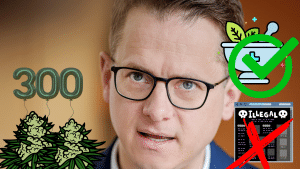

On 15 October 2026, the German Bundestag passed its emergency care reform and, in the process, corrected one of the most controversial cannabis rules of the summer. With the votes of CDU/CSU, SPD and the Greens, and with AfD and Die Linke abstaining, Parliament also adopted Amendment 11. It rewrites Section 31(6) of the Social Code Book V (SGB V), which the GKV Contribution Rate Stabilisation Act had only tightened at the end of July.
What changes
Until now, the law required every new cannabis therapy covered by statutory health insurance (GKV) to begin with a six-month trial of an approved cannabis-based finished medicinal product. The sentence was added to the austerity bill just days before it was passed in July and has caused considerable uncertainty ever since.
Going forward, the priority rule only applies to finished medicines within the indication for which they are approved. The fixed six-month period is gone. How long a therapy trial lasts will be decided by physicians based on medical criteria.
This matters most for pain patients. The available finished medicines, such as Sativex, Canemes and Epidyolex, are approved for narrowly defined indications, and chronic pain is not among them. Under the KBV’s previous interpretation, practices would still have had to prescribe one of these products off-label first.
An end to the interpretation dispute
In August, the National Association of Statutory Health Insurance Physicians (KBV) and the National Association of Statutory Health Insurance Funds (GKV-Spitzenverband) initially agreed that the priority rule only applies where a product is approved for the indication in question. The KBV later abandoned this reading and asked lawmakers for clarification. The new wording essentially adopts the original joint interpretation.
The episode is still remarkable. In response to a parliamentary question from the Greens, the federal government had conceded that it expects no significant financial impact from the priority rule. No study justifying exactly six months was cited.
Existing patients: protected, but only in the explanatory memorandum
Patients already being treated with extracts, dronabinol or a compounded preparation do not have to switch to a finished medicine. However, lawyer Judith Heimbürger (gunnercooke) points to a residual risk in a guest article for Legal Tribune Online: the exemption only appears in the explanatory memorandum, not in the statutory text itself. In addition, the protection is tied to the indication. If a new condition is diagnosed, the priority rule applies to it.
Her verdict on the back and forth of recent months is clear: “A consistent and, above all, reliable health policy for patients looks different.” (translated from German)
What remains: flower stays out
The decision does nothing to change the reimbursement status of cannabis flower. Since 30 July 2026, flower can no longer be prescribed at the expense of statutory health insurance, with no grandfathering or hardship provision. Social courts are divided on previously issued approvals: Frankfurt and Leipzig rejected patients’ urgent applications, while Dresden and Landshut consider final approvals to remain in effect. A ruling by a higher court is still pending.
The cost question is also unresolved. According to calculations by the German Hemp Association (DHV), flower is the cheapest cannabis medicine per milligram of THC. Patients who switch to extracts or finished medicines are not prescribed less active ingredient, so therapy is more likely to become more expensive. The Health Finance Commission, by contrast, calculates per patient and reaches the opposite conclusion. A real-world data analysis by the BPC also shows that only around 0.5 percent of patients switch between flower and extracts each month, while the savings estimate assumed 10 percent.
Even if you consider the cost calculations shaky, on both sides, one point gets too little attention in the debate: where medical cannabis is prescribed, opioid use often declines. A cohort study from Israel found fewer opioid prescriptions after six months among pain patients receiving physician-supervised cannabis treatment. An analysis published in JAMA Oncology links the legalisation of medical cannabis in the US to a five to twenty percent drop in opioid dispensing to cancer patients under 65. These are largely observational data from abroad, and randomised trials are still lacking. But anyone discussing the cost of cannabis flower should also factor in the costs and risks of the therapies prescribed instead.
What happens next
The law still needs to pass the Bundesrat and be published in the Federal Law Gazette. Until then, Section 31(6) SGB V remains in force in its current version. For practices, pharmacies and manufacturers, it is worth documenting ongoing cases carefully in the meantime.
The correction shows that lawmakers are willing to revisit a rule after two months if it delivers no benefit. The question is whether they will apply the same standard to flower.
Sources: German Bundestag, Committee Recommendation 21/8629; Federal Government Response 21/8148; LTO, Judith Heimbürger, 14 October 2026; German Hemp Association (DHV); BPC; JAMA Oncology; PLOS ONE.