At their June 17–19 conference in Hamburg, Germany’s 16 state interior ministers (the “IMK”) voted on a hardline proposal from the state of Hesse that would have gutted key parts of Germany’s 2024 partial cannabis legalization. The two most damaging proposals — a public consumption ban and a freeze on new cultivation-association licenses — were both rejected. For anyone building in Germany’s craft/community cannabis space, that’s genuinely good news. The reason they failed is arguably the more interesting story.
Some background for non-German readers
Germany legalized limited personal cannabis use and possession in April 2024 under the Consumer Cannabis Act (Konsumcannabisgesetz, or KCanG). Unlike the commercial dispensary model familiar from many U.S. states, Germany’s “second pillar” runs through Anbauvereinigungen aka Clubs: Non-profit cultivation associations, roughly comparable to cannabis social clubs in Spain or Malta. Adult members can grow and acquire cannabis collectively under strict rules, but no commercial retail sale is permitted. Adults may possess up to 25 grams in public and 50 grams at home.
Germany’s interior ministers meet twice a year as the IMK to coordinate policing and security policy. They’re not lawmakers, but their resolutions carry real political weight — federal ministries often act on them, and IMK positions shape the coalition debate.
What Hesse wanted
Hesse’s interior minister, Roman Poseck (CDU, the center-right Christian Democrats), brought a four-part proposal to effectively reverse the 2024 reform:
- A blanket ban on public consumption — well beyond the current restrictions near minors, schools, daycares, and playgrounds.
- A freeze on new licenses for cultivation associations — no new craft/community grow clubs.
- Lower legal possession limits.
- Restored investigative powers (like communications surveillance) for cannabis-related offenses, curtailed when cannabis left the narcotics law.
Poseck leaned on Germany’s second interim evaluation report (published by the EKOCAN research consortium in March 2026) to make his case — even though that report actually found no reform-driven increase in consumption, and specifically flagged cultivation associations as underused, not overused, as a tool for displacing the black market.
The result: two of four rejected
- ❌ No public consumption ban. Existing rules stand — no consumption in sight of schools, daycares or playgrounds, none in pedestrian zones 7am–8pm — but nothing broader was added.
- ❌ No freeze on cultivation-association licenses. New associations can keep forming and applying for licenses under existing law, uninterrupted.
- ✅ Lower possession limits requested. The IMK is asking the federal interior ministry to push for reduced limits — the stated rationale: the current 25-gram public limit makes it easier for black-market dealing to hide behind legal possession.
- ✅ Review of investigative powers requested. The federal interior and justice ministries are asked to examine restoring powers like communications surveillance for cannabis offenses.
The two approved points are requests for federal ministries to review — not binding law changes, and nothing takes effect immediately.
Why the hardline push failed: a procedural rule, not a policy defeat
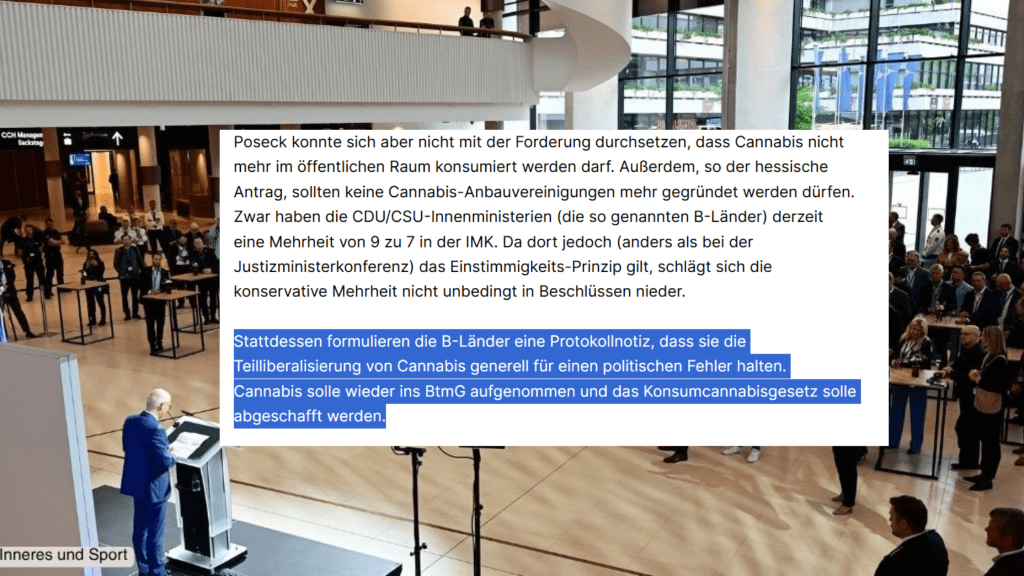
Here’s the detail that makes this more than a routine “ministers argue, nothing happens” story. Conservative (CDU/CSU) states currently hold a 9-to-7 majority within the IMK. But unlike Germany’s parallel conference of justice ministers, the IMK operates by unanimous consent — a simple majority isn’t enough to pass a binding resolution. Hesse’s proposal wasn’t defeated on the merits; it was blocked procedurally. The SPD-led states only needed to withhold consent on the two sharpest points.
One irony worth noting: the pushback on the cultivation-license freeze came from host city Hamburg itself, whose SPD interior senator, Andy Grote, is personally no fan of legalization — a sign this was more interstate horse-trading than any sudden enthusiasm for cannabis policy.
Unable to force a binding resolution, the conservative-led states attached a formal dissenting note to the record instead. In it, they call Germany’s partial legalization a policy mistake outright and demand that cannabis be put back under the narcotics law and the KCanG repealed entirely. Not binding — but a clear preview of where this fight resurfaces: the next IMK, in December 2026, again under Hamburg’s chairmanship.
Why this matters if you’re watching the German market from abroad
For anyone tracking Germany’s craft-cultivation / social-club model — a structure quite different from U.S. state-licensed commercial retail — this outcome is meaningfully positive. Until at least December, nothing stands in the way of craft cannabis made in Germany, grown through cultivation associations: they can keep forming, keep scaling membership, and keep operating without new licensing hurdles.
Don’t read this as Germany’s political class embracing cannabis, though. The dissenting note from conservative states shows real appetite for a full rollback still exists. The actual inflection point is the government’s final evaluation report, legally due no later than April 1, 2028 — that’s what both sides are waiting on to make their case, and it’s likely to shape every IMK session between now and then.
Worth flagging separately: on the medical side, a parallel legislative push (the MedCanG amendment, which would restrict cannabis mail order and telemedicine prescribing) remains stuck in committee and is unlikely to pass before the summer recess — no near-term change there either, but it’s the same underlying political climate and worth watching in parallel.
Reactions
Germany’s Left Party (Die Linke) had already criticized Hesse’s original proposal as ignoring the government’s own evaluation data and putting youth protection and consumer health at risk. Poseck, for his part, framed even the watered-down outcome as a win, emphasizing that the IMK still expressed a critical stance toward legalization overall and secured a review of enforcement powers.
Bottom line: until at least the next IMK session in December, nothing stands in the way of craft cannabis made in Germany, grown through cultivation associations. The political appetite to roll things back hasn’t gone away — it’s just waiting on the final federal evaluation report.
Sources: Legal Tribune Online (LTO), June 16 and June 19, 2026; Anwaltsblatt/DAV, July 1, 2026; IMK resolution “TOP 39 HE CanG nach Einigungsgespräch.”