Since Monday, Britain's largest pharmacy chain has been prescribing medical cannabis. The headlines were everywhere yesterday. The more interesting question sits behind the news: is this the moment cannabis moves out of the niche of specialist clinics and into mainstream healthcare? And where in Europe could something similar happen next?
What Boots launched
On 16 November 2026, Boots UK launched a new service called SureLeaf through its Boots Online Doctor platform. It targets adults aged 25 and over with chronic pain, generalised anxiety disorder or insomnia who have not found relief with conventional treatments.
The process is deliberately clinical: an online questionnaire, a review by a clinical team, then a video consultation with a specialist. Before treatment starts, a second, independent specialist reviews every prescription. Patients are then reviewed after 28 days and at least every three months after that.
Prescriptions cover flower and oil, sold under Boots' own SureLeaf brand. Importantly, products are delivered by post, not handed over the counter in its roughly 1,800 stores.
The model behind the brand is lean. It is run by Boots Digital Health, the company behind Boots Online Doctor, which is registered with the Care Quality Commission. According to Boots, the products come from a single UK supplier it does not name. Industry outlet Stratcann notes that the description "UK-only, carbon-negative" matches Glass Pharms. Dispensing runs through a pharmacy registered with the GPhC, and products are delivered to the patient's home. One of the first strains is called Lemon Cherry Hybrid, with 25 percent THC in a 10-gram pack. Flower is taken with a vaporiser, and patients with a history of psychosis are screened out.
The pricing is a statement to the market:
- Trial month: £89 including initial assessment, a 10 ml starter dose of oil and an end-of-month check-in
- Annual plan: £99 including initial assessment and four follow-up consultations
- Medicine on top: flower from around £38, oil from around £35
Alongside the launch, Boots is exploring a research programme with the University of Nottingham on treatment outcomes, prescribing practice and patient experience in chronic pain. That is not a footnote but part of the strategy: it buys Boots credibility with doctors and regulators.
Why a high-street chain moves more than the next clinic
The UK now has more than 40 private cannabis clinics. Telemedicine, home delivery, subscription models: all of that already existed. Technically, Boots is not inventing anything new.
What Boots brings is something else: trust and visibility. Boots is where people buy sun cream, plasters and their antibiotics. It sits on every high street; it is the brand of mothers, pensioners and commuters. When that brand says "medical cannabis is a serious treatment option", it reaches people who would never have visited a cannabis clinic's website.
Two numbers show how big that lead is. Boots runs around 1,770 pharmacies in the UK; the runner-up, Well, has just over 700. And in online advertising Boots plays in a league of its own: an industry report estimates Boots' monthly ad spend at more than £5 million, compared with under £1,000 for Well. Visibility is exactly what the UK cannabis industry has been missing. No clinic can buy that kind of reach.
For the industry, this means three things:
- Normalisation. The "stoner clinic" stigma loses its footing when the provider is the same one that gives you your flu jab.
- Price anchor. £99 a year for clinical support puts the established clinics under price pressure.
- Own brand. Boots is not selling just any product; it is selling SureLeaf. Any producer or importer that wants onto this shelf in the UK will be negotiating with a retail group, not a start-up.
In my view, that last point is underestimated. It is the classic drugstore model: the chain owns the customer relationship, and manufacturers become interchangeable.
Has this happened before?
Yes and no. In the UK, a few smaller pharmacy groups have offered partnerships before: Clear Chemist works with Curaleaf Clinic, Right Medicine runs a referral service, and the Scottish Dickson Chemist group even set up its own cannabis clinic. But these were regional players that passed patients on to specialist clinics or filled their prescriptions. None of the big chains, neither Superdrug, Well nor LloydsPharmacy, has offered its own cannabis service so far.
The closest international comparison is Canada. In January 2019, Shoppers Drug Mart, the country's largest drugstore and pharmacy chain, launched its own online shop for medical cannabis, including a support centre and home delivery. But Shoppers did not prescribe. Patients had to bring their own medical document; the chain sold and advised.
That is what sets Boots apart. To my knowledge, Boots is the first major retail brand in Europe to hold the whole chain in one hand: its own brand, its own specialists, its own prescribing and products under its own label. Cannabis is no longer a specialist offer you get referred to, but a product in the regular health portfolio of a mainstream brand, alongside weight-loss jabs, hair loss treatment and travel vaccines.
A milestone for how the industry communicates
That is why I see 16 November as a milestone, less in regulatory terms than in communication. Medical cannabis has, for the first time, been given a place in the middle. It becomes part of a perfectly normal marketing mix: brand presence, clear prices, a trial subscription, targeted messaging, cross-selling through a platform millions of people already use.
Until now, the industry's communication has lived in two worlds. On one side, clinics and platforms that relied heavily on performance marketing, scene aesthetics or the already convinced community. On the other, pharmaceutical companies that, for regulatory reasons, could barely communicate at all. What was missing was the middle: a brand that simply says "this is a treatment option, here is the serious way to get there".
Boots closes that gap, and that has consequences for everyone else. Anyone advertising for patients in the UK will now be measured against Boots' tone. For continental Europe it is a blueprint for positioning the topic without sliding into the "stoner corner" and without hiding behind jargon.
The media reaction proves the point
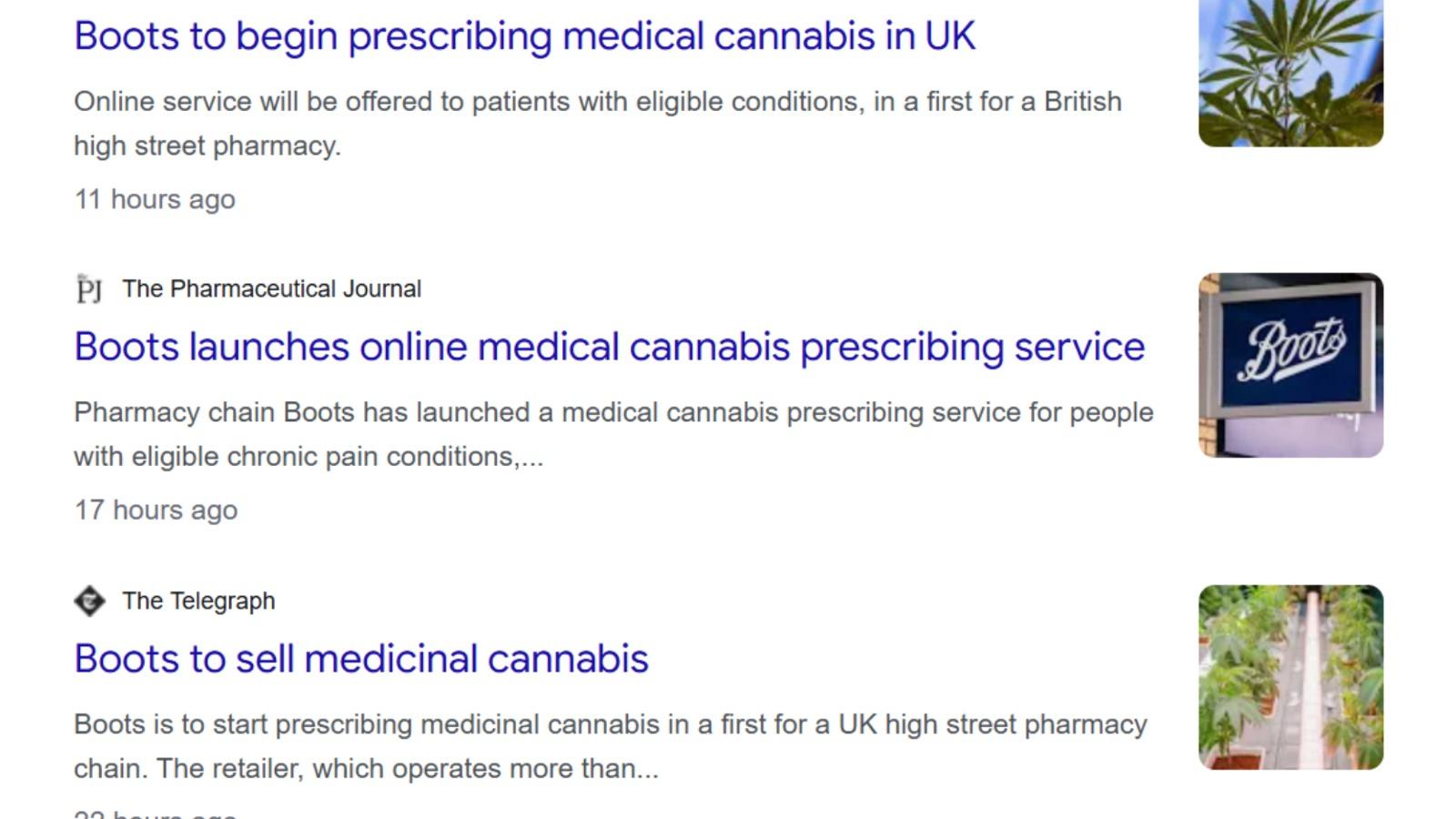
How strong the signal is became clear within hours. Talk radio station LBC broke the story, and by Monday evening Boots was everywhere: national outlets like The Guardian and GB News, retail trade titles like Retail Gazette and The Grocer, pharmacy press like The Pharmaceutical Journal, The Pharmacist and Pharmacy Magazine, regional news in Nottinghamshire, and of course the international cannabis trade media from MJBizDaily to Stratcann.
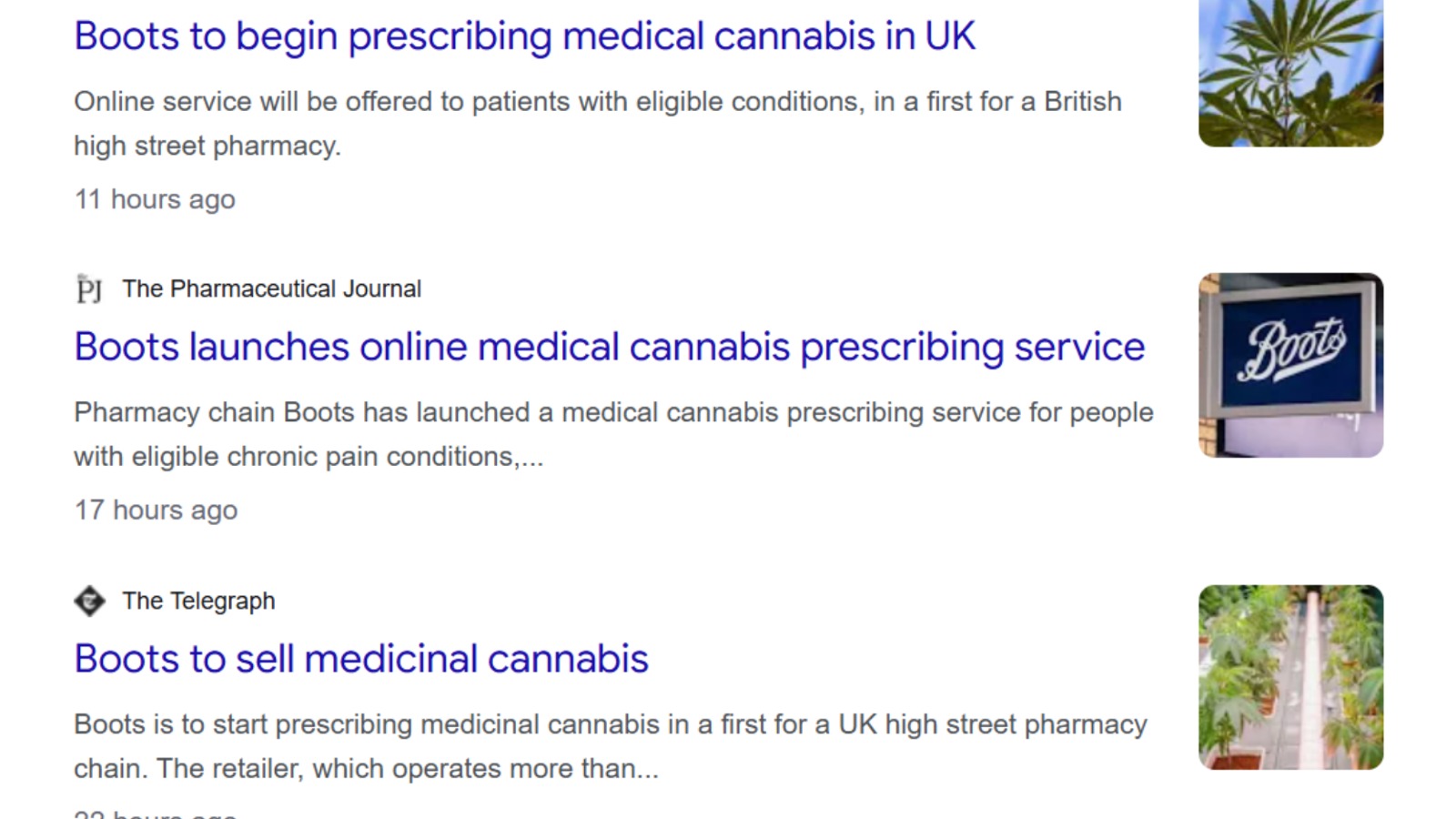
No cannabis clinic in the UK has ever generated that kind of coverage with a launch. It took a brand everyone knows. That is exactly the visibility effect this article is about: the story is no longer "cannabis", the story is "Boots".
The awareness gap: the UK has a visibility problem, not a supply problem
Medical cannabis has been legal in the UK since November 2018. Yet NHS prescriptions remain practically non-existent; the market runs almost entirely privately, with patients paying out of pocket.
The numbers show strong growth from a low base:
- Private prescriptions more than doubled, from around 283,000 (2023) to around 659,000 (2024).
- Estimates of patient numbers vary widely because there is no central register: from 60,000 to 75,000 active patients up to around 100,000 in 2025. For 2026, around 124,000 patients and a market of almost £300 million are expected.
- At the same time, only a fraction of eligible specialists prescribe cannabis at all; estimates put the number at around 100.
For comparison: around a quarter of adults in Britain report chronic pain, and about five million people live with chronic insomnia. And a significant share of those already using cannabis still buy it on the black market.
That is the core of my argument: the gap between need and supply in the UK is no longer a regulatory problem but a marketing and trust problem. Many people simply do not know it is legally possible. Or they consider the clinics dubious. A brand like Boots can close exactly that gap without a single change to the law.
So I expect not only more patients at Boots, but a pull effect for the whole market. Someone who hears about the option through Boots for the first time will not necessarily end up at Boots. They compare. The category grows, and every provider benefits, even as margins get tighter.
The Hims & Hers pattern: health as a lifestyle category
To understand who Boots is really targeting, look at Hims & Hers. The US company showed how to take topics like hair loss, erectile dysfunction, weight loss or mental health out of the waiting room: discreet, digital, with a clean brand and a subscription.
The target group is exactly the one that makes the difference for cannabis too. Working people between 25 and 55 with a concrete problem (they sleep badly, have back pain, are constantly tense), who do not want to see their GP and have no interest in a scene aesthetic. Boots SureLeaf is essentially the Hims & Hers model with the trust bonus of a pharmacy brand that is more than 170 years old.
And Hims & Hers itself is already in Europe: in 2025 the company acquired Zava, a platform with more than 1.3 million active customers in the UK, Germany, France and Ireland. Whether Zava eventually adds cannabis to its portfolio is, for me, not a question of if, but of regulation and reputational risk.
SureLeaf's indications are no coincidence either: pain, anxiety, sleep. These are exactly the volume indications that also drive the self-pay market in Germany. At the same time, the evidence for anxiety disorders in particular is contested. A recent review finds very little robust evidence there, and somewhat more for sleep. With its second reviewer, the age limit of 25 and the research programme, Boots is guarding itself against precisely this criticism.
The Europe map: where a Boots moment is even possible
For something like SureLeaf to emerge, two things are needed at once: pharmacy chains with capital and a brand, and a legal framework in which cannabis is prescribed at meaningful scale. That combination is rare in Europe.
The reason lies in pharmacy law. In large parts of Western Europe, only pharmacists may own a pharmacy, which structurally rules out chains on the British or American model. Large chains have therefore grown mainly where regulation allowed it: in the UK, Ireland, Scandinavia, the Baltics and Central and Eastern Europe.
| Country | Pharmacy chains | Medical cannabis | Boots scenario |
|---|---|---|---|
| United Kingdom | Yes, no limits | Private market, approx. 100,000+ patients | Live since 16 Nov 2026 |
| Ireland | Yes (incl. Boots) | Very restrictive: 74 patients in the programme since 2021, review under way | Chains ready, regulation holding back |
| Switzerland | Yes (Galenica with Amavita, Sun Store) | Prescribable without special permit since August 2022 | High; Galenica bought the cannabis pioneer pharmacy in Langnau in 2022 |
| Czech Republic | Yes (Dr. Max, approx. 529 branches) | In pharmacies since 2013, specialists only, e-prescription, quantity cap | Medium; chain and framework in place, small market |
| Poland | Restricted since 2017: new pharmacies for pharmacists only, existing chains remain | One of the largest patient markets in the EU | Medium; Dr. Max opened a cannabis compounding pharmacy in 2021 |
| Netherlands | Yes | Long available via pharmacies, small market | Low, little growth pressure |
| Italy | Opened to corporate owners in 2017, with caps | Limited, supply heavily state-shaped | Low to medium |
| Scandinavia (NO, SE) | Yes | Extremely restrictive | Low |
| Germany | No, ban on third-party ownership | Largest market in the EU, mostly self-pay | Only via platforms and EU mail-order pharmacies |
| France, Spain | No | Very restrictive | Very low |
The picture is almost ironic: the countries with big chains often have hardly any cannabis patients, and the country with the most patients has no chains. The UK is currently the only large market in Europe where both come together. That explains why the move happened there.
For continental Europe, the most interesting candidates in my view are Switzerland and the Czech Republic. In Switzerland, Galenica, the largest pharmacy group, showed years ago that the topic is on its radar when it acquired Bahnhof Apotheke Langnau. In the Czech Republic and Slovakia, Dr. Max, by its own account Europe's largest pharmacy chain by number of branches, runs its own omnichannel strategy. And Ireland is the obvious test case: Boots is present, and the government is reviewing its failed access programme. If the programme opens up, the infrastructure is there immediately.
Germany: why the Boots moment looks different here
There will be no SureLeaf from dm or Rossmann in Germany. The ban on third-party ownership in the German Pharmacy Act allows only a pharmacist to own a pharmacy personally, with at most three branches. Drugstore chains may not dispense prescription medicines. Full stop.
Still, something structurally similar is happening in Germany, just from the other direction. The role a retail chain plays in the UK is played here by telemedicine platforms combined with specialised mail-order pharmacies. Of the roughly 16,600 pharmacies, only about 4,000 are active in cannabis supply at all. Supply already runs through a manageable number of specialised players, just without a well-known retail brand at the top.
Three developments changed the picture in 2026:
- Since 30 July 2026, cannabis flower can no longer be prescribed at the expense of statutory health insurance. The flower market is now almost entirely self-pay, which is exactly the British model.
- The amendment to the Medical Cannabis Act (MedCanG), which would require in-person doctor contact for first prescriptions and ban mail-order of flower, has still not been passed as of November 2026. As long as that holds, the platform economy remains the dominant model.
- Demand is huge. The Federal Ministry of Health expects imports of around 300 tonnes of flower in 2026.
So the question for Germany is not whether a drugstore chain will move in, but who will take on the role of the trusted mass-market brand. The candidates are the big EU mail-order pharmacies with their own online doctor, international telehealth groups such as Hims & Hers via Zava, or an alliance of local pharmacies. Whoever gets there first, without drawing regulatory fire, wins the audience that today is still caught between the black market and uncertainty.
Who's next? The candidates by type of player
If I rank the players by who could most plausibly follow Boots, I get this order:
- British competitors with their own online doctor. Superdrug, LloydsPharmacy Online Doctor and the online doctor services of the supermarket chains already have the infrastructure for online prescribing. If SureLeaf works, a follow-up within twelve months is likely.
- Large pharmacy chains in countries with an open framework. Galenica in Switzerland, Dr. Max in the Czech Republic and Slovakia. The legal framework fits; what is missing is market size.
- Direct-to-consumer platforms. Hims & Hers with Zava and the well-known European online doctor providers. They have the audience, the brand and the technology, but also the biggest reputational risk with investors.
- EU mail-order pharmacies. In Germany the most obvious channel for a "mass-market cannabis brand", but facing strong regulatory headwinds.
- Drugstores without a pharmacy. dm, Rossmann and co. stay out. Their playing field is CBD, hemp cosmetics and perhaps one day education, not prescriptions.
For start-ups in the industry, the message is clear. The phase in which a small clinic or platform opens up the market with pioneering spirit is ending in the UK right now. Anyone who cannot become a brand themselves should ask which of the big players they want to be a supplier, technology partner or acquisition target for.
Conclusion
Boots is not the starting gun for the British cannabis market; that has been running since 2018. But it is the starting gun for a new phase: away from the specialist provider, towards the mass-market brand. The biggest obstacle to growth in the UK was recently no longer the law, but a lack of awareness and trust. That is exactly what a chain on every high street delivers.
For continental Europe, the scenario remains limited to a few countries where chain law and cannabis law fit together. Switzerland, the Czech Republic and, in the longer run, Ireland are the candidates I would watch. In Germany, the mass-market brand will not come from the high street but from the internet. The race to become Germany's "Boots for cannabis" is already on. It just does not have a name everyone knows yet.
Sources
- Boots Online Doctor: SureLeaf
- Boots Online Doctor: SureLeaf overview
- Stratcann: UK's Largest Pharmacy Chain Launches Online Medical Cannabis Service
- The Pharmacist: Boots launches medical cannabis service for chronic pain
- Pharmacy Magazine: Boots launches £99-a-year medical cannabis service
- PatientsCann UK: Boots SureLeaf
- Cannabis Equipment News: Major UK Pharmacy to Offer Medical Cannabis Prescriptions
- MJBizDaily: UK medical cannabis to be offered at Boots
- Retail Gazette: Boots becomes first UK high street pharmacy to launch medical cannabis service
- The Grocer: Boots is first major UK retailer to offer medical cannabis
- GB News: Boots to start prescribing medical cannabis
- ScrapeHero: Boots Pharmacy locations UK 2026
- ClickThrough: UK Pharmacies Digital Marketing Benchmark Q1 2026
- Business of Cannabis: UK market data
- Releaf: How many medical cannabis patients are there in the UK?
- Business of Cannabis: Ireland MCAP review
- Business Wire: Hims & Hers to acquire Zava
- Loblaw: Shoppers Drug Mart launches ecommerce platform for medical cannabis (2019)
- Clear Chemist: Medical Cannabis
- Galenica: Cannaplant and Bahnhof Apotheke Langnau
- Wikipedia: Dr. Max Group
- Springer / JoPPP: OTC and pharmacy regulation in 30 countries
- Echo24: Cannabis at health insurers' expense
- Hanf Magazin: Imports and telemedicine