First, Understand: What Is DocMorris?
DocMorris is Europe’s largest online pharmacy. The model is straightforward: you have a prescription from your doctor, upload it to the app, and your medication arrives by post — often cheaper than at a local pharmacy.
That’s the catch. In Germany, prescription medications are subject to a strict fixed-price system. No pharmacy can undercut another, and none can advertise with bonuses. But DocMorris is based in the Netherlands — and successfully invoked EU single market freedoms. The European Court of Justice ruled: foreign mail-order pharmacies are not bound by Germany’s fixed-price rules. They can offer discounts on Rx products.
The ECJ’s reasoning was logical: when a patient arrives at a mail-order pharmacy with a completed prescription, the medical decision has already been made. The doctor has ruled. The prescription exists. What happens next is a pure consumer choice — where do I buy? A discount at this stage no longer influences any medical decision, so it can cause no harm.
This became known as the DocMorris Privilege — a competitive advantage over German pharmacies, built on a clear temporal logic.
Why Bloomwell Thought It Applied to Them Too
The thinking was understandable. If DocMorris can advertise Rx bonuses because the doctor has already decided — why couldn’t a platform like Algea promote medical cannabis, as long as no specific product or manufacturer is named?
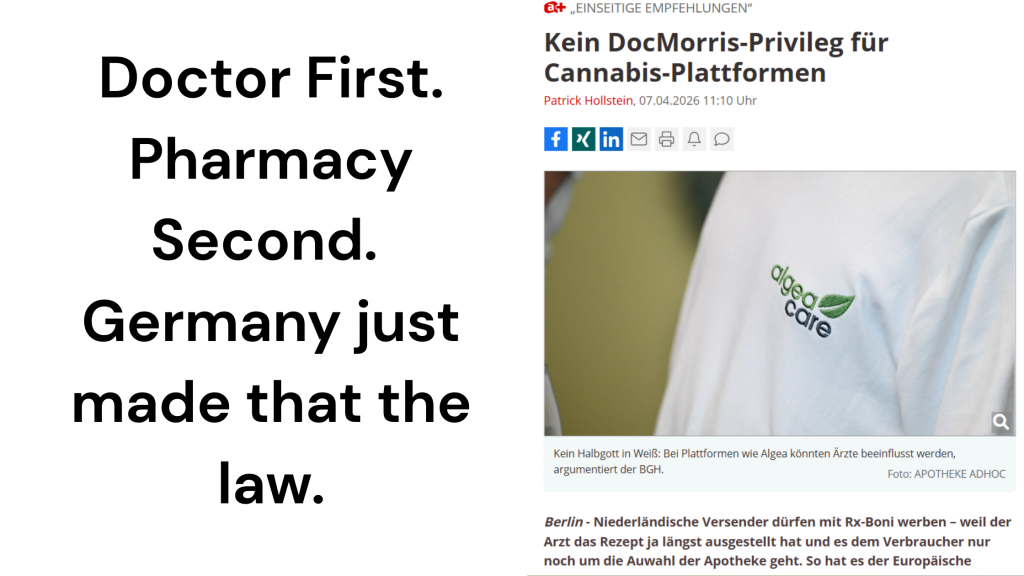
The German competition authority (Wettbewerbszentrale) disagreed and filed suit. The case reached Germany’s Federal Court of Justice (BGH).
What the BGH Actually Decided
The BGH rejected the transfer of the DocMorris Privilege to cannabis platforms. Not for technical reasons — but for a structural one: the timing is fundamentally different.
With DocMorris, the patient arrives with a completed prescription. The decision is done.
With Algea, the patient arrives with complaints. The platform guides them toward cannabis therapy, presents indications, and routes them to a cooperating doctor — with a clear therapeutic expectation already formed. The prescription decision is still entirely open — and is being actively shaped by the platform.
The BGH identified several points that would each be sufficient on their own. Together, they are decisive:
1. Product reference exists even without naming a product Algea had not advertised a specific cannabis product. No manufacturer, no SKU. It didn’t matter. The BGH clarified: advertising for an entire class of prescription medicines — here, all cannabis products for medical purposes — can still satisfy the required product reference under the German Medicines Advertising Act (§ 10 HWG). The law does not only protect against advertising for individual preparations.
2. One-sided presentation is not education Algea argued it had merely informed users — about indications and possibilities, much like any manufacturer does in a package insert. The BGH rejected this. The content was not neutral information. It was designed to influence demand for medical cannabis at cooperating doctors. One-sided presentation of benefits, without a complete therapeutic context, is advertising — not education.
3. The vertical structure is not background noise — it’s evidence This is where it gets particularly relevant for investors. The BGH looked beyond the Algea website to the corporate structure behind it: a group seeking to cover the entire cannabis value chain — cultivation, processing, platform, doctors, pharmacies. The court said explicitly: given this setup, it is reasonable to assume that patients routed through Algea to a cooperating doctor — and prescribed cannabis — would also obtain it through the group’s own pharmacy marketplace. This makes the commercial interest in the prescription self-evident. And that makes the advertising unlawful.
What This Means for Founders
This ruling changes the compliance logic for an entire category of business models.
Telemedicine providers with a cannabis focus need to reassess their patient journey. The critical question is not whether cannabis is advertised by name — it’s whether the platform sends users to a doctor with a pre-formed therapeutic expectation. Indication lists plus a booking button equals advertising under the law. That is now BGH case law.
Vertically integrated models carry an elevated burden of proof. The more value chain stages a company controls, the more scrutiny every individual piece of communication faces. Corporate structure is not neutral background — in a dispute, it may be the strongest argument against you.
Content strategies need a clean line between information and sales promotion. That line is sharper than many founders assumed. Factual information about which indications may warrant cannabis consideration is generally permissible. One-sided recommendations for cannabis, prompts to actively request a prescription, routing to cooperating doctors with an implied therapeutic expectation — that is not.
What Investors Need to Price In
This ruling is not an abstract legal dispute. It is a BGH signal with direct portfolio implications.
Anyone who has invested in European cannabis startups — or is considering it — should add three questions to their due diligence:
Is the core funnel a patient-to-doctor flow with a cannabis focus? If yes, this ruling is not a theoretical risk. It is current law.
How many value chain stages does the company control? The more integration, the greater the compliance exposure of every single communication.
Is there an ECJ clarification? No. The BGH explicitly declined to refer the case to the European Court of Justice. The German position is set — the European debate, especially in the context of the ongoing MedCanG reform, remains open.
The Actual Signal
The DocMorris Privilege works because it rests on a clear temporal logic: doctor first, then pharmacy, then advertising. Cannabis platforms wanted to apply that logic in reverse. The BGH refused.
What remains is a simple insight for the entire industry: the next chapter of the German medical cannabis market will not be written by the most aggressive funnel builders — but by the structurally cleanest models. Any company combining doctor routing, indication advertising, and vertical integration in a single product is sitting on a ticking compliance clock after this ruling.
Those who restructure now have a real competitive advantage.
Every company navigating this environment needs partners who understand both the regulatory landscape and the business reality. At Cannabis-Startups.com, we work with founders and investors across Europe to help them build models that are not just ambitious — but defensible.
This article is based on BGH ruling I ZR 74/25 (Bloomwell/Algea), as reported by Apotheke Adhoc on April 7, 2026. It does not constitute legal advice. For individual assessment, we recommend consulting a specialist in pharmaceutical advertising law.