How Germany’s cannabis legalisation anniversary played out in the media — and what the science actually says
The Weekend’s Media Echo in One Sentence
Conservative interior ministers dominated every headline. The data told a different story.
On 1 April 2024, Germany’s Konsumcannabisgesetz (KCanG) — the Recreational Cannabis Act — came into force as part of the broader Cannabisgesetz (CanG). Two years later, the media coverage around the anniversary is loud, polarised, and structurally tilted. Most of what reached the front pages this weekend came from CDU and CSU politicians who opposed the law from day one. The scientists running the official evaluation were, once again, barely audible.
What the Media Reported This Weekend
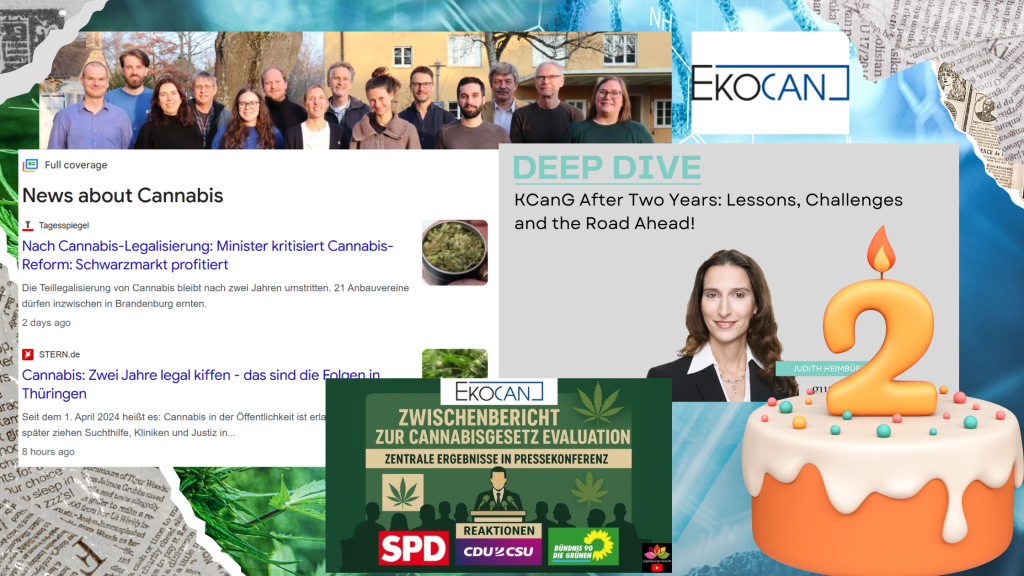
Brandenburg Interior Minister Jan Redmann (CDU) set the tone: two years after the partial legalisation, he drew a negative conclusion, arguing that cannabis cultivation associations had failed to push back the black market. (Tagesspiegel / Nordkurier, 28 March 2026)
His exact words, cited by dpa: “The demand generated by partial legalisation is barely being met by home cultivation and growing associations. Instead, the illegal structures of the black market are profiting from legalisation — and thereby strengthening distribution channels for more dangerous drugs.”
Hessian Interior Minister Roman Poseck (CDU) went further, calling partial legalisation a lasting mistake and stating: “In the overall balance, there are hardly any winners, but many losers. This law strengthens the interests of the few at the expense of society.” He also argued that from a policing perspective, the KCanG has not reduced the workload — it has significantly increased it, requiring additional evidence before officers can stop, search or control individuals. (Osthessen-News / BrachinaImagePress, 27 March 2026)
Federal Interior Minister Alexander Dobrindt (CSU) had already called the law “a proper piece-of-shit law” (Scheißgesetz) in October 2025 when presenting a new BKA report on organised crime — a quote that resurfaces in nearly every anniversary piece. (taz, November 2025)
BKA President Holger Münch added institutional weight this week: “There is still a large black market for cannabis in Germany. What’s growing in German cultivation associations, on balconies and windowsills, cannot come close to meeting consumer demand. Alongside deliveries from Spain and Morocco, we are now also seeing large volumes coming in from the US and Canada.” (dpa-AFX / Finanznachrichten, March 2026)
The headline that spread widest across FAZ, Stern, Tagesspiegel and regional outlets: Germany recorded a record seizure volume in 2025 — customs alone confiscated more than 50 tonnes of cannabis, compared to roughly 24 tonnes seized jointly by police and customs in all of 2024. (Hasepost / News-Eilmeldung, 30 March 2026)
What most headlines buried: the FAZ’s own investigative reporting found that a main driver of the seizure increase is changed smuggling routes, not a larger black market per se. Cannabis from North America — particularly Canada and the US — is now flooding European ports. The customs spokesman for Cologne put it bluntly: “We’re experiencing a flood of marijuana shipments from the US. We are being swamped — there’s no other way to put it.” The Dutch customs authority separately reported a fourfold increase in cannabis finds, to over 60 tonnes. (finanznachrichten.de / ad-hoc-news.de, January 2026)
What the Science Says — and What Judith Heimbürger Presented
On 26 March 2026 — four days before the second anniversary — cannabis lawyer Judith Heimbürger (gunnercooke, Frankfurt) delivered a Deep Dive session titled “KCanG After Two Years: Lessons, Challenges and the Road Ahead”. Her presentation draws directly on the official EKOCAN evaluation data and provides the analytical framework that is largely absent from the weekend’s media coverage.
On decriminalisation — the headline number: Cannabis-related criminal offences dropped by 80 percent from Q1 2024 to Q2–Q4 2024. The EKOCAN researchers describe the partial legalisation as the most significant decriminalisation measure in German history by volume. For cannabis consumers, the risk of criminal prosecution has largely ceased to exist.
On consumption — the core contested claim: The EKOCAN study’s finding is direct: a review of the results does not suggest that the Cannabis Act led to a significant increase in use among adults in the first year after it took effect. The slight rise in prevalence was already underway before partial legalisation. This directly contradicts the dominant framing in conservative political messaging. (Source: EKOCAN study / Bundesgesundheitsministerium FAQ, March 2026)
On cultivation associations — the real structural problem: As of 3 March 2026, 836 applications had been submitted to establish cultivation associations nationwide. Only 397 had been approved — just under 47 percent. (Source: Federal Working Group of Cannabis Cultivation Associations / BCAv, cited in Heimbürger presentation)
One year earlier, the picture was even worse: of 593 applications filed by early March 2025, only 133 had been granted. (bpb.de, March 2025)
The CAD (Cannabis Cultivation Associations Germany) has consistently argued that this is a political problem, not a conceptual one: “The politicians put a stick in the spokes of the cultivation associations and then complain that they’re not running fast enough. Whoever weakens cultivation associations is strengthening the black market — that is the simple truth behind these [interior ministry] papers.” (CAD press release, December 2025)
On the Second Pillar — the missing piece: Heimbürger’s presentation makes explicit what the political debate routinely avoids: over 60 applications have been filed with the Federal Office for Agriculture and Food (BLE) for regional scientific model projects — the planned licensed retail stores that constitute the law’s “second pillar.” So far, not a single one has been approved. The BLE considers the legal basis insufficient. Ongoing lawsuits against the BLE are pending.
Without this second pillar, experts consistently argue that meaningful black market displacement is not achievable. The taz summarised the scientific consensus bluntly: “Only through it could the black market really be effectively suppressed.” (taz, November 2025)
The Missing Report — The Hottest Political Potato
By law (Section 43 KCanG), a second interim report was due by 1 April 2026, specifically covering the law’s impact on cannabis-related organised crime. This report would need to contextualise the BKA’s data — exactly the data that is currently being weaponised in the media narrative.
The Greens in the Bundestag filed a formal inquiry about the status of this report, asking how the coalition’s “open-ended evaluation” relates to the legally mandated EKOCAN timelines and what scientific independence guarantees are in place. (Bundestag, hib, 2026)
As of the time of writing, the second interim report has not been confirmed by the federal government. Heimbürger noted this explicitly in her presentation. The silence is telling.
The Political Landscape Heading Into Year Three
The current CDU/CSU–SPD coalition agreed in its coalition treaty on an “open-ended evaluation” — a compromise formula that prevents direct repeal while keeping the door open for restrictions. Key political positions as of March 2026:
CDU/CSU: Publicly hostile. Health Minister Tino Sorge has repeatedly called the legalisation “a dangerous wrong turn.” The CSU pushed hard for full repeal during coalition negotiations. Bavaria continues to actively obstruct implementation at state level. The CDU party congress voted in February for repeal. And yet: even among CDU voters, 46 percent support full legalisation with licensed shops — the party leadership’s hard line is out of step with its own electorate.
SPD: Defending the status quo while staying quiet. The party that pushed the law through under Karl Lauterbach successfully blocked outright repeal in coalition negotiations. Friedrich Merz himself acknowledged that cannabis is “no longer a priority topic” for the CDU. But forward movement — towards licensed stores or model projects — is off the table under this coalition.
Greens: In opposition, continuing to push for the second pillar and licensed retail. They are monitoring the evaluation closely to prevent “politically motivated tightening” of a law the science does not yet justify changing.
One data point that rarely appears in the weekend’s coverage: legal cannabis associations are estimated to currently cover roughly 0.1 percent of estimated demand.
A system covering 0.1 percent of demand cannot logically be evaluated as a market-level intervention — yet it is being assessed as exactly that.
Assessment: Who Controls the Narrative?
The media echo of this anniversary weekend reveals a structural asymmetry in the German cannabis debate. The loudest voices are those who opposed the law before it was written. The EKOCAN data — peer-reviewed, methodologically careful, produced by Hamburg-Eppendorf, Düsseldorf and Tübingen — barely makes it into the headline slot.
The actual two-year verdict: a half-finished law, deliberately left incomplete for political reasons, is producing half-finished results — and being blamed for exactly the gaps that political obstruction created.
As Heimbürger concluded her presentation: “Two years after the introduction of the KCanG, the picture is mixed. Decriminalisation is working, but the black market persists due to the lack of widespread legal alternatives. Coming years will be decisive in determining whether the legislation can achieve its intended impact.”
Whether the new federal government uses those years — or quietly hollows out the law through inaction and bureaucratic friction — is the real question at the two-year mark.
Sources: Deep Dive presentation by Judith Heimbürger (gunnercooke, 26 March 2026); EKOCAN evaluation study (UKE Hamburg-Eppendorf / Düsseldorf / Tübingen); Tagesspiegel, dpa-AFX, taz, FAZ, Osthessen-News, BCAv, CAD e.V., Hanfify, Grünhorn, bpb.de, Bundestag hib — all accessed 29–30 March 2026.