There are weekends that change the political landscape. The last one was one of them. After Thursday's heated hearing in the Health Committee and a controversial SZ commentary over the weekend, one thing is clear: the cannabis debate is no longer a sideshow; it has become the litmus test for political culture in Germany.
Let me put the events into context and analyze what they mean for our industry, for patients and for the political future.
Thursday's hearing: what was really said
While the Union warns, with an eye on the media, of "recreational use under the guise of medical benefit", the experts at the hearing painted a very different picture:
Dr. Kirsten Müller-Vahl (physician) made it clear: "Many medicines carry a considerably higher risk of dependence" than cannabis. Her warning is urgent and should make all of us sit up and listen: "Shutting down telemedicine is the wrong path if we want to prioritize youth protection."
The larger the illegal market grows, the less youth protection there is. This logic is compelling, and the Union consistently ignores it.
Georg Wurth (Deutscher Hanfverband) delivered shocking accounts from practice: patients who call every doctor's office in their region, without success. His statement was crystal clear: "Local practices are in no way able to meet the demand from patients." That is not ideology; that is reality.
Christiane Neubaur (VCA) dispelled the myth behind the mail-order ban: this is not about "large Dutch mail-order companies" but about local German pharmacies that have specialized. In rural areas there are no pharmacies left at all, and a mail-order ban would cause supply to collapse.
Ferdinand Weiß (specialized lawyer) summed it up: there is no regulatory problem, but rather an "enforcement deficit". The laws already exist; they are simply not being enforced.
The Süddeutsche strikes back
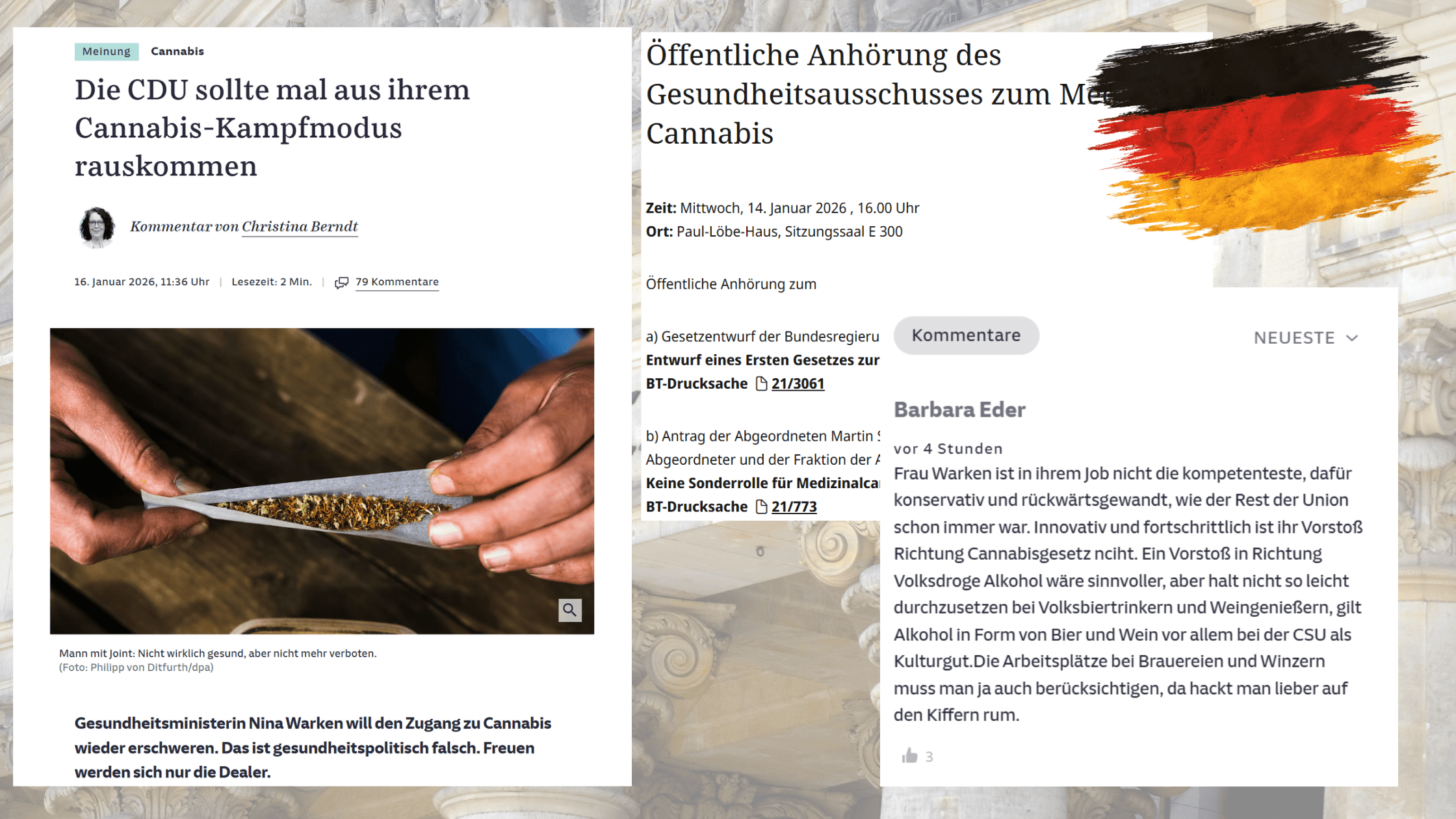
Christina Berndt's commentary over the weekend, "The CDU should finally get out of its cannabis combat mode", struck a nerve. The reactions were fierce, emotional and revealing.
What interests me most as an industry observer: the comments section became a mirror of the division in society. More than 40 detailed comments and hundreds of social media reactions show that cannabis has gone from a fringe issue to a symbol of the culture war.
The three narratives that shaped the weekend
1. The indictment of alcohol (the strongest argument)
"Booze in your brain definitely makes you dumber than THC": this sarcastic comment received massive approval. The double standard can no longer be overlooked:
- Oktoberfest as cultural heritage
- Beer as the Bavarian elixir of life
- Jobs in breweries must be protected
- But cannabis? That has to go!
One commenter put it in a nutshell: "Can we also agree for once that alcohol is a drug too, and in terms of its potential for harm the worst one? It is the only drug that is more dangerous to the people around the user than to the user themselves."
What this means for our industry: The double standard argument is our greatest asset. We need to play it louder and more often.
2. Bavaria: the empirical proof that prohibition has failed
"Before legalization, despite its restrictive policy, Bavaria had the highest per capita consumption in all of Germany."
This figure was quoted dozens of times over the weekend, and it is devastating for the Union's position. Bavaria's hardest line did not lead to less consumption, but to the highest. Prohibition has failed empirically.
What this means for our industry: We have the data on our side. Prohibition does not work, and of all places, Bavaria proves it.
3. The patient perspective (emotionally the strongest)
After Wurth's account at the hearing, the patients' stories gained new urgency. "Patients with less severe illnesses are patients too": this statement should go without saying, yet the Union calls it into question.
One particularly moving comment described supply problems in a socially disadvantaged neighborhood. Teenagers smoke weed in stairwells, dealers approach minors. The criticism: "The current cannabis law was made for a respectable middle-class clientele."
What this means for our industry: We have to take patient care seriously, and that means ALL patients, not just the middle-class ones. This is an entrepreneurial and a social responsibility.
What the numbers reveal: follow the money
At the hearing, Georg Wurth cited a figure that makes people sit up: legal revenue of one billion euros is at stake. On top of that:
- Tax revenue (currently several hundred million)
- Jobs in cannabis clubs, pharmacies and telemedicine
- Specialized service providers and start-ups
- Research and development
Rolling back the law would not make this money disappear; it would flow back into the black market. Organized crime would be handed a gift.
What this means for our industry: The economic dimension must be communicated more strongly. This is about real jobs, real tax revenue and real economic strength.
The beer hall strategy: why it backfires
With cannabis, citizen's income, migration and gender, the Union is trying to take issues away from the AfD. One commenter aptly analyzed: "It's not about the substance, it's an attempt to take issues away from the AfD in order to score points in elections. The opposite will happen."
The calculation is simple: whoever adopts AfD issues legitimizes the AfD as the one setting the pace. Whoever argues at beer hall level loses urban, educated voters. The Union loses on both sides.
What this means for our industry: The Union's hardline cannabis position is not a matter of conviction but a matter of tactics. It is temporary and will have to be walked back after the election.
The enforcement deficit: the elephant in the room
Ferdinand Weiß's reference to the "enforcement deficit" is the most important point of the entire hearing. The Heilmittelwerbegesetz already prohibits advertising to consumers. Why is it not being enforced?
The answer is uncomfortable: because it is politically easier to call for new bans than to enforce existing laws. Symbolic politics instead of administrative work.
What this means for our industry: We have to take compliance seriously. Black sheep in the industry put all of us at risk. Self-regulation is not only ethically required but also strategically smart.
What became clear over the weekend: 6 insights
- The double standard can no longer be defended. Alcohol vs. cannabis: this comparison will haunt the Union.
- The experts stand united against the Union. From Müller-Vahl to Wurth to Neubaur, the specialists agree.
- The coalition arithmetic does not work. Without the AfD there is no majority for a rollback.
- The young generation is mobilized. Cannabis has become a symbol of freedom.
- The economic dimension is underestimated. 1 billion euros in legal revenue is no small change.
- Patients are the losers. Every tightening hits the most vulnerable.
The Monday after the storm
As I write these lines, the weekend is over. The comments have been written, the social media debates have died down. What remains?
A deep division in society. A Union that insists on a course rejected by experts, coalition partners and a large part of the population. An industry in limbo. And patients who do not know whether they will still have access to their medicine tomorrow.
Christina Berndt was right: the Union should get out of its cannabis combat mode. It will not do so, at least not before the election on February 23. After that, reality will return: the coalition arithmetic, the expert opinions, the developments in Europe.
Until then, the motto is: hold on, document, communicate.